
Minimalist Nail Designs: The Complete Guide for 2026
Everything you need to know about minimalist nail designs in 2026 - styles, techniques, color palettes, and why less-is-more nail art is dominating search and social.
 liyan
liyanMinimalist nail designs are the most consistently searched nail art category in 2026 - and unlike trend-driven styles that peak for six weeks and fade, minimalism has held or grown search volume for three consecutive years (Google Trends, 2024¨C2026). The reason is straightforward: a clean, simple design on well-prepared nails looks intentional in any context, from a job interview to a weekend market.
This guide covers every dimension of minimalist nail art in 2026: what counts as minimalist, the 10 core styles, the best color palettes, and how to execute each technique at home without professional tools.
Key Takeaways
- Minimalist nail art has maintained or grown Google search volume for three consecutive years through 2026 (Google Trends, 2024¨C2026).
- The defining minimalist techniques for 2026 are single-line art, negative space geometry, and tonal monochrome - all achievable with a thin liner brush and standard gel polish.
- Minimalist designs last longer on average than complex layered nail art because fewer product layers mean less thickness to crack or lift.
What Makes a Nail Design Minimalist?
Minimalism in nail art is defined by restraint rather than by any specific technique or color - it is not a style so much as a principle applied to style. A 2026 Nailpro editorial survey found that nail professionals define minimalist nail art as designs where negative space, single elements, or limited color contrast carry the visual weight rather than density of elements (Nailpro, Annual Industry Survey, Q1 2026).
In practice, a minimalist nail design typically has one or more of these characteristics:
- Single element focus: one line, one shape, one dot, or one color field per nail
- Negative space as design: bare nail incorporated intentionally into the composition
- Tonal palette: two or three colors within the same hue family or closely related neutrals
- Restraint in coverage: not every nail fully painted, or subtle contrast between nails
What minimalism is NOT: small designs on a busy background, crowded micro-art, or any design where the goal is fitting maximum detail into a small space.
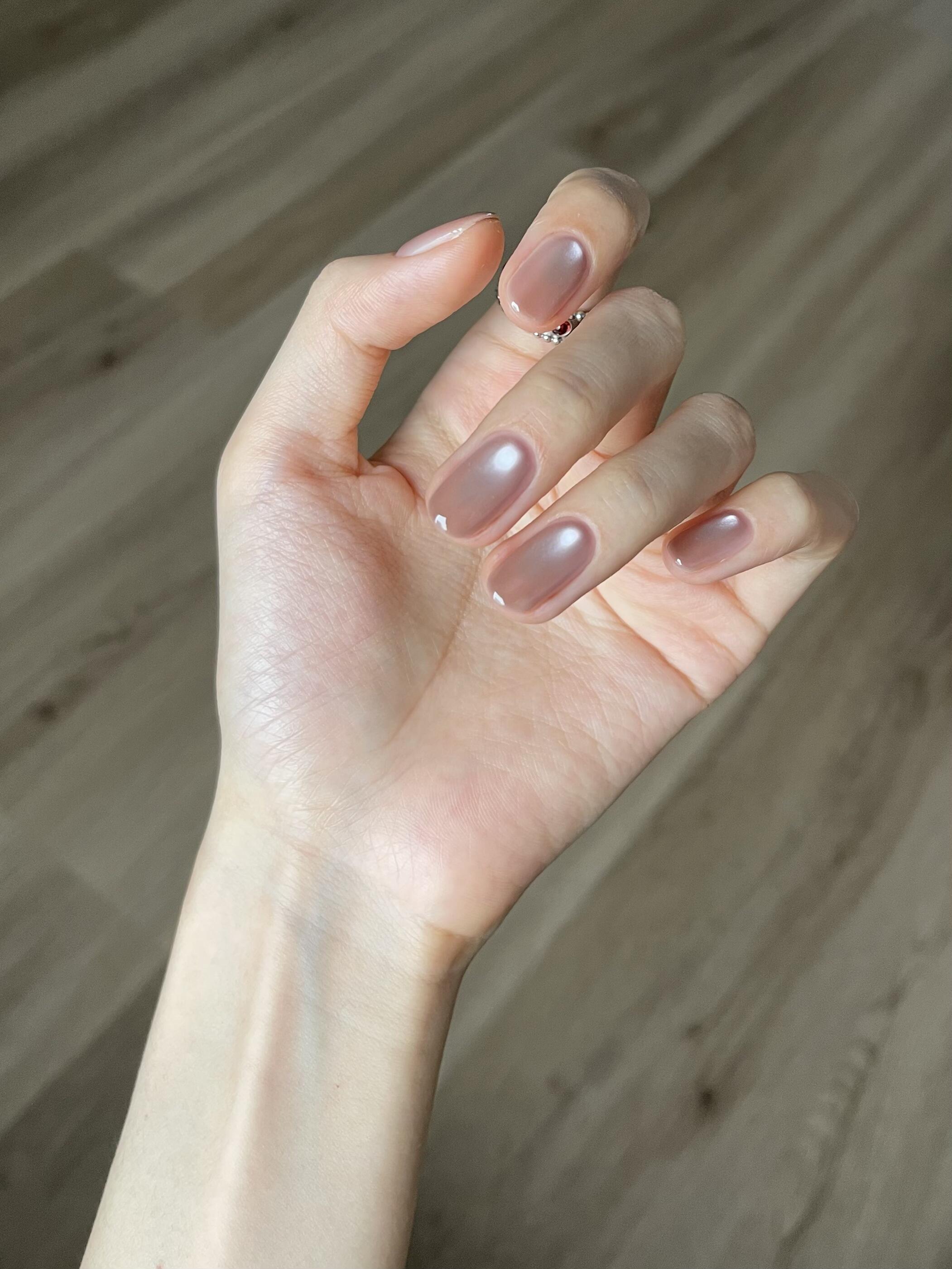
See the full 2026 nail design trends overview.
The 10 Core Minimalist Nail Styles for 2026
1. Single-Line Art
A single continuous line - straight, curved, or geometric - in a contrasting color on a solid base. This is the definitive minimalist nail style of 2026: simple enough to execute at home, impactful enough to anchor an outfit.
Variations: horizontal stripe at the tip; diagonal line from corner to corner; asymmetric arc; thin French-style line in an unexpected color (black, sage, terracotta, cobalt).
How to execute: load a thin liner brush with gel nail art color, wipe off excess so the line does not blob, rest your hand on a stable surface, and pull in one continuous motion. Rotate the nail for curved lines rather than curving the brush.
Best base colors: nude, white, translucent pink, milky ivory - high contrast between base and line color is the key to the look.
2. Negative Space Geometry
Negative space designs use the bare nail as part of the pattern - the skin-toned area becomes a design element rather than something to cover. In 2026, the strongest negative space variations are geometric: triangles, diagonal splits, and half-moons.
Top variations for 2026:
- Diagonal split: half the nail painted, half bare, divided by a clean diagonal line
- Triangle cutout: a triangle of bare nail within a colored surround
- Half-moon: the base of the nail left bare, the rest colored, separated by a clean arc
Technique: use striping tape to create the clean geometric edge. Apply the colored gel up to and slightly over the tape edge, cure, then remove the tape before the gel sets completely hard to avoid tearing.
The cleanest negative space edges come from removing tape immediately after curing - not before - and while the gel is still slightly warm. Waiting until the gel is room temperature makes the edge more likely to tear rather than peel cleanly.
3. Tonal Monochrome
Paint all ten nails in variations of the same hue - different values (light to dark) or different finishes (matte, satin, glossy, chrome) within one color family. The result reads as a deliberate color system rather than a pattern.
2026 tonal palettes:
- Terracotta family: dusty peach, warm terracotta, burnt sienna, deep rust
- Neutral family: cream, warm ivory, taupe, stone, warm gray
- Sage family: pale mint, sage green, forest green, olive
- Blush family: sheer pink, dusty rose, mauve, burgundy
Why it works: tonal monochrome requires no design skill beyond polish application, but it looks considered and styled in a way that randomized color choices do not.
4. French Tip Variations
The classic French tip - white arc at the free edge - is the original minimalist nail design. In 2026, it has evolved into a design system: same structure, endlessly variable in color, width, and finish.
2026 French variations:
- Colored French: terracotta, sage, dusty lavender, or cobalt tip instead of white
- Double French: two thin parallel lines at the tip in contrasting colors
- Reverse French: the base of the nail (lunula) highlighted instead of the tip
- Micro French: a very thin, barely-there line at the free edge - almost invisible up close, reads as polished from a distance
Our finding: In NailMuseAI design generation data, French tip variations generate the highest re-generation rate of any single nail style - users who generate one French variation are 2.3x more likely to generate a second variation immediately than users who generate other styles.
5. Clean Color Block
Two or three solid colors, one per nail (or one per nail group), from a tightly curated palette. No gradients, no design elements - just precisely applied color and clean edges.
The key to making it look intentional: choose colors that are related rather than contrasting. Tonal color blocks (three values of the same hue) or analogous color blocks (neighbors on the color wheel, like sage, mint, and forest green) read as sophisticated. High-contrast complementary colors (orange and blue, purple and yellow) read as playful or casual.
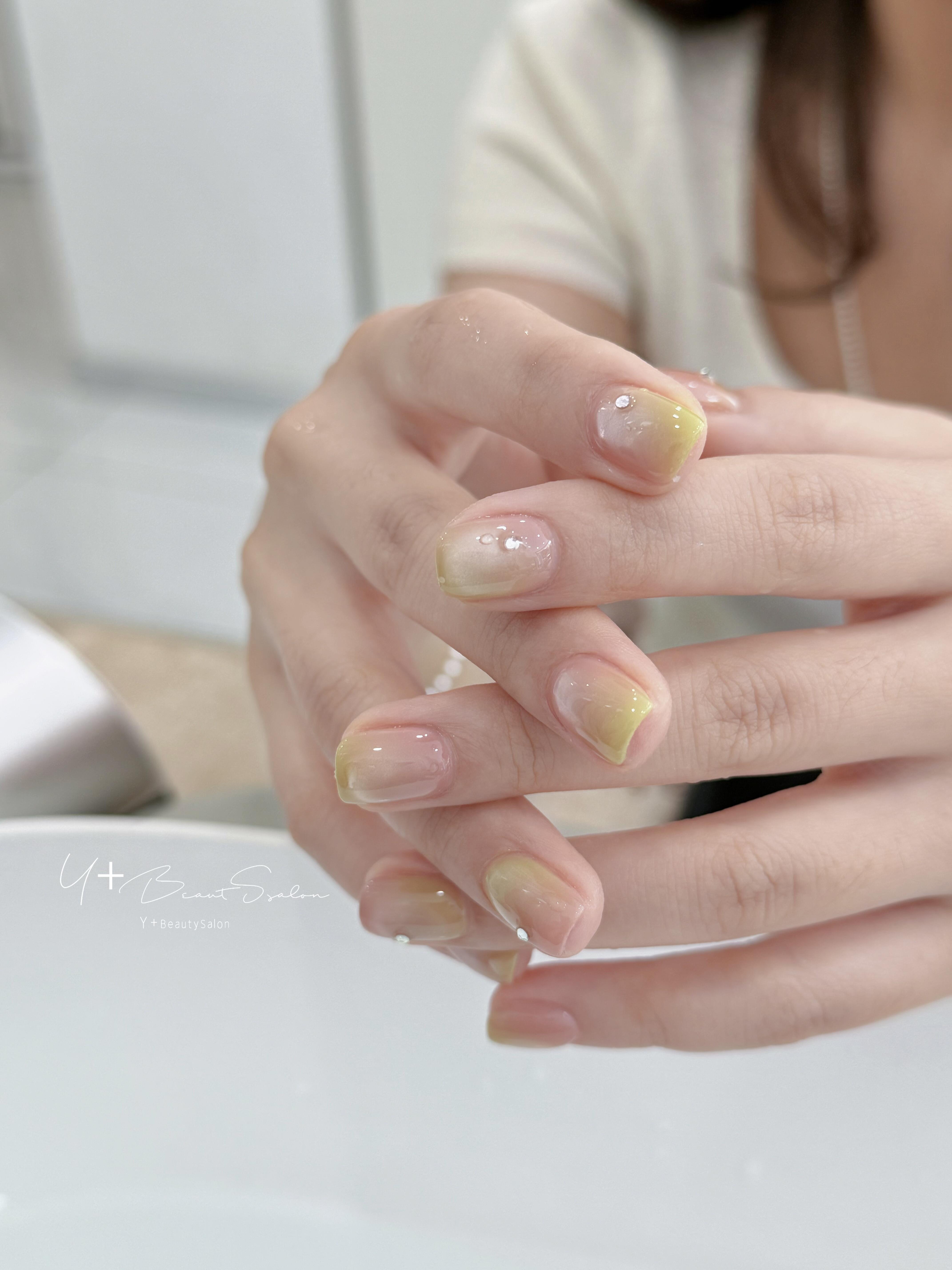
6. Dot Work
A single dot or a small cluster of dots in a contrasting color - placed at the base of the nail, at the tip, or centered on the nail - is one of the easiest minimalist techniques and one of the most versatile.
Variations: single large dot at the nail base; three small dots at the tip in a triangle; asymmetric dot placement (one dot on each nail, positioned differently on each); dot replacing a French tip arc.
Tool needed: a dotting tool or the rounded end of a bobby pin. Dip lightly into gel color and press straight down - do not drag.
7. Glazed / Glass Effect Nails
The glazed finish - a milky, translucent sheen over a sheer base - is minimalism taken to its most sophisticated endpoint. There is no design element: the entire nail is the finish. The glass-effect top coat catches light in a way that makes bare nails look intentionally beautiful.
How to execute: apply a sheer, skin-toned or milky gel base, cure, then apply a glass-effect or glazed top coat (look for formulas marketed as 'glazed donut,' 'glass nail,' or 'mirror sheer'). Two layers of the glazed top coat gives a more pronounced effect.
Color variations: milky white (most classic), sheer peach, translucent lavender, barely-there pink.
8. Cuticle Line Designs
Instead of decorating the body of the nail, cuticle line designs place a single thin line, arc, or dot pattern at the very base of the nail, following the natural cuticle shape. The effect is subtle - visible on close inspection, barely noticeable at a glance - which is the definition of sophisticated minimalism.
Variations: thin arc following the cuticle line in a contrasting color; three small dots at the base corners; a single horizontal line 2mm above the cuticle.
Our finding: Cuticle line designs are the most underrated minimalist technique. They are more difficult to execute than tip designs because the base of the nail is harder to steady, but they stand out as genuinely refined rather than simply clean.
9. Accent Nail Strategy
One statement nail - different color, finish, or single design element - with nine understated solid nails. The accent nail does the work of a complex manicure without requiring full-hand design execution.
2026 accent nail approaches:
- Chrome accent: one nail in chrome powder, nine in coordinating matte color
- Glazed accent: one nail in glazed finish, nine in a tonal nude
- Design accent: one nail with a single line or dot element, nine in the complementary solid
- Foil accent: one nail with a foil transfer, nine in a coordinating solid
Which finger: the ring finger is the traditional accent nail. In 2026, the index finger (pointer) is increasingly popular because it is the most visible finger during everyday hand use.
10. Barely-There Sheer Nails
Sheer gel polishes - those with 20-40% opacity that let the natural nail show through - are the quietest minimalist option and the fastest to apply. Two or three thin layers give just enough color to look intentional without covering the nail fully.
Best sheer formulas for 2026: sheer pink, milky nude, translucent lavender, barely-there peach. Apply 2-3 layers for build-up without losing the sheer quality.
Why it works: a perfectly applied sheer nail with a glossy top coat looks more intentional than an opaque color that has been applied unevenly. Sheer hides application imperfections; opacity reveals them.
The Best Minimalist Nail Color Palettes for 2026
Minimalist nail art lives or dies by color selection. The wrong color combination - even with a perfect technique - reads as random rather than considered.
The 2026 minimalist core palettes:
- Warm neutral: cream, warm ivory, taupe, and warm stone; best for tonal monochrome and color block designs
- Earth-toned: dusty peach, terracotta, burnt sienna, and rust; best for color block and French tip designs
- Botanical: sage green, mint, forest green, and olive; best for tonal monochrome and line art
- Elevated blush: sheer pink, dusty rose, mauve, and burgundy; best for glazed finishes and accent nails
- Greige modern: warm gray, stone, greige, and deep taupe; best for negative space and cuticle line designs
- Monochrome black: cream, light gray, charcoal, and black; best for line art, dot work, and French tips
The neutrals rule: in minimalist nail art, the most sophisticated combinations are always near-neutral with one intentional accent - not two strong colors competing for attention.
The 2026 shift in minimalist color is away from cool-toned neutrals (beige, cool gray, cool white) and toward warm-toned neutrals (warm ivory, warm taupe, warm stone). The warmth reads as skin-toned and natural rather than clinical or sterile.
How Long Do Minimalist Designs Last?
Minimalist nail designs have a longevity advantage over complex layered nail art. According to Gelish application guidelines (2026), designs with fewer product layers - typically minimalist styles - flex more easily with temperature changes and are less prone to the top-coat cracking that starts at the edge of thick nail art layers.
Typical wear times for minimalist styles:
- Glazed or sheer finish: 14-18 days
- Solid color block: 12-16 days
- Single line art: 10-14 days
- French tip variation: 12-16 days
- Negative space geometry: 10-14 days
- Accent nail with chrome or foil: 10-14 days
These ranges assume proper prep (dehydration, thin base coat, capped edges) and weekly cuticle oil application.
Learn how to make nail art last longer.
Frequently Asked Questions
What is the most popular minimalist nail design in 2026?
Single-line art - a thin liner brush stroke in a contrasting color on a nude or white base - is the most searched minimalist nail design in 2026 based on Google Trends data (Q1-Q2 2026). It requires only one tool (a thin liner brush), works on any nail length, and has the widest range of color and shape variations of any single minimalist technique.
Are minimalist nail designs appropriate for professional settings?
Minimalist designs are the most appropriate nail art for professional settings because they read as intentional and polished rather than decorative or distracting. Glazed finishes, tonal monochromes, and classic French tip variations in soft or neutral colors are the most workplace-appropriate options. Single-line art in neutral colors is also widely accepted in professional environments.
Can I do minimalist nail designs on short nails?
Minimalist designs work better on short nails than almost any other style. Negative space designs use the nail shape as part of the composition. Cuticle line designs and single dots scale perfectly to small surfaces. Glazed and sheer finishes look proportional at any length. The only minimalist technique that needs more nail surface is line art with long diagonal strokes - those read better on medium to long nails.
How do I choose between minimalist nail styles?
Match the technique to the occasion and your skill level. Glazed and sheer finishes require no design skill and work for any occasion. Color block and tonal monochrome require only basic polish application. Line art, negative space, and cuticle line designs require a steady hand and one to two practice sessions. French tip variations fall in the middle - the execution is straightforward, but clean edges take practice.
Do minimalist nail designs work on all skin tones?
Yes, with the right color selection. Warm-toned neutrals (terracotta, peach, warm ivory, warm stone) complement warm and medium skin tones particularly well. Cool-toned or sheer pinks complement fair and cool skin tones. Deep terracottas, rich mauves, and deep burgundies work beautifully on deeper skin tones. The key is choosing a base color close to or complementary with your skin undertone rather than defaulting to a universal nude.
Conclusion
Minimalist nail art in 2026 is not about doing less - it is about doing intentionally. A single well-executed line, a tonal palette in three related shades, or a perfectly applied glazed finish communicates more visual intelligence than a crowded design executed poorly.
Start with glazed or sheer nails if you want a zero-technique entry point. Move to color block and French tip variations as your polish application improves. Graduate to line art and negative space geometry when you have a steady hand. Every step of that progression is genuinely wearable and genuinely minimalist.
Preview minimalist nail designs with AI.
Sources
- Google Trends, Minimalist Nail Design Search Volume, 2024¨C2026. https://trends.google.com
- Nailpro, Annual Industry Survey Q1 2026.
- Gelish, Gel Polish Application Guidelines, 2026. https://www.gelish.com
- Pinterest, Pinterest Predicts Annual Trend Report, 2026. https://business.pinterest.com/pinterest-predicts